
Advertisement

Editor, November 06, 2026
12
5 min(s) read
Advertisement
Precious Nwonu, Enugu
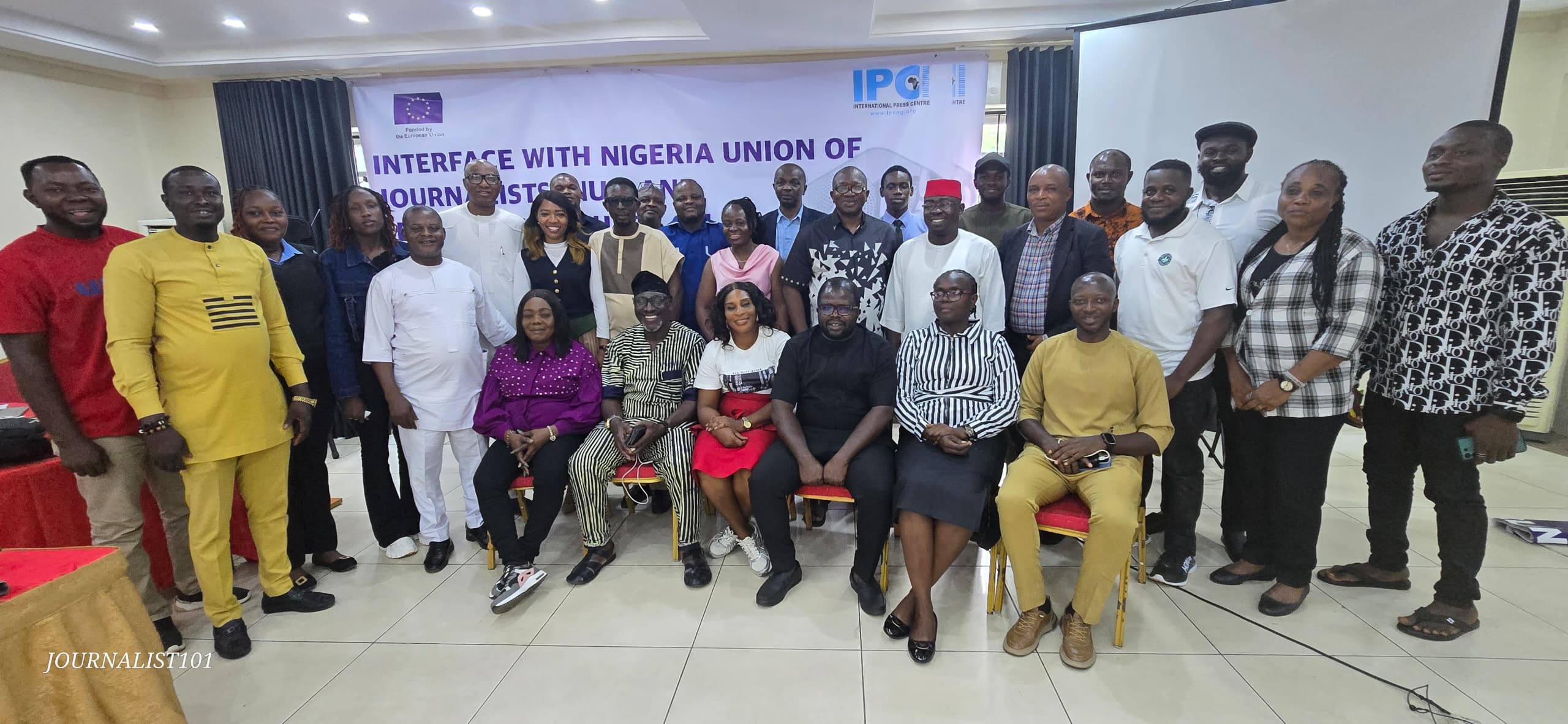
The International Press Centre (IPC), Lagos, has trained journalists in Enugu State on professional and democratic accountability journalism ahead of the 2027 General Elections.
The two-day workshop, held from November 4 to 5, 2026, brought together broadcast, print and online journalists to strengthen their capacity for responsible electoral reporting.
The engagement was organised under Component 4 (Support to Media) of the European Union Support to Democratic Governance in Nigeria (EU-SDGN III) project, with a focus on promoting issue-based reporting, fact-checking, accountability journalism and credible electoral coverage.
The first day of the workshop featured sessions for broadcast and print journalists, while the second day involved an interface with the Enugu Online Media Practitioners (EOMP) and a capacity-building session for journalists.
In his welcome address, the Executive Director of IPC, Dr Lanre Arogundade, said the engagement was important as the country prepares for another general election, stressing the need for journalists to provide credible, balanced and public-interest information.
Arogundade said elections should go beyond political campaigns, rallies, candidates and the announcement of results to include the aspirations, concerns and expectations of citizens.
He urged journalists to move away from event-driven electoral coverage and pay greater attention to issues affecting Nigerians, including the economy, education, healthcare, security, employment and infrastructure.
“This is why we must begin to look beyond event-driven electoral coverage towards more substantive, issue-based, and citizen-centred reporting,” he said.
He also warned that sensationalism, unverified claims, inflammatory statements and the spread of misinformation could undermine public confidence, deepen divisions and weaken democratic institutions.
According to him, fact-checking and verification must become an essential part of responsible electoral reporting, particularly with the growing influence of digital platforms in the spread of false information and manipulated content.
Arogundade further called on media organisations to give women, young people, persons with disabilities and other underrepresented groups greater visibility in electoral discussions.
He said the success of the training would be measured by the quality of stories journalists publish, the claims they verify, the concerns they amplify and the accountability questions they ask ahead of the elections.
The first session was facilitated by the Director of UNIZIK 94.1 FM, Nnamdi Azikiwe University, Awka, Professor Ifeoma Dunu, who spoke on the topic, “2027 General Election in the Context of Democratic and Accountability Reporting: Scanning the Electoral Environment and Reporting Citizens’ Priority Concerns.”
Dunu urged journalists to move beyond routine coverage of political parties, candidates, campaign rallies, endorsements and defections, stressing the need to investigate political promises and examine how government decisions affect citizens.
She noted that effective election reporting should focus on public needs, democratic rights, policy choices, the integrity of electoral institutions and the performance of those seeking public office.
“The central argument of this paper is that effective election journalism must move beyond reporting what politicians say to investigating what they do, verifying what they say, what they claim and establishing how their decisions affect citizens’ lives,” she stated.
The professor explained that democratic reporting examines citizens’ participation, rights, fairness, transparency and inclusion, while accountability reporting investigates whether public officials and institutions fulfil their responsibilities.
She identified the electoral and legal environment, political activities, institutional structures, economic conditions, social inclusion, public services, security and the information environment as areas journalists must monitor ahead of the 2027 elections.
Dunu also encouraged journalists to make citizens’ concerns a priority in their editorial decisions rather than allowing politicians to determine the news agenda.
She identified unemployment, the rising cost of living, insecurity, access to healthcare, education, electricity, water, roads, corruption and public spending as some of the major issues journalists should investigate and demand answers from political candidates.
The second session of the workshop was facilitated by Olusola Oludiran, a Nigeria Democratic Report (NDR) and IPC Fact-checker, who anchored a extensive training session titled “Integrating Fact-Checking for Democratic and Accountability Reporting” alongside “Basic Fact-Checking Tools and Techniques.”
Oludiran noted that while fact-checking is a subset of journalism, the process itself is highly investigative and structurally more rigorous than regular news or feature writing. He explained that the rapid deterioration of the digital landscape makes active intervention essential for the press.
“The media cannot be said to be performing its role without serving as a sanitiser of the much-tainted information space, especially in a fast-paced information ecosystem eroded with false information,” he said. “Hence the need to integrate fact-checking into its operations.”
He cautioned that modern professionals face a heavily compromised information ecosystem where complex forms of “information disorder” categorised by intent into misinformation, disinformation, and malinformation threaten democratic health.
He emphasized that this threat escalates rapidly during election periods through the use of fabricated stories, manipulated visuals, fake election results, and AI-driven deepfakes.
“The use of generative AI can intensify election deception by making fake text, images, audio, and video faster, cheaper, and more convincing,” Oludiran explained. To counter this, he urged journalists to remain strictly non-partisan and adhere strictly to the ‘ABC Fact-Checking Cycle’: Assume nothing, Believe nothing, and Check everything.
Following the theoretical framework, Oludiran led a practical session to train participants on how to deploy specialized verification tools. The journalists were taught to utilize digital platforms such as Archive PH, Is this AI, Hive Moderation, TruthScan, InVID + TinEye and a whole lot of fact checking tools, to check image, video, and audio scores, locate original media sources, and conduct video manipulation checks.
Concluding his session, Oludiran emphasized that technical proficiency must be paired with human judgment. “No tool is 100% accurate,” he reminded the participants. “Evidence not virality determines the verdict.”
It takes a lot to get credible, true and reliable stories.
As a privately owned media outfit, we believe in setting the pace and leaving strides in time.
If you like what we do, you can donate a token to us here. Your support will ensure that the right news is put out there at all times, reaching an unlimited number of persons at no cost to them.
Comments expressed below by readers do not reflect the opinions of Pacesetter Frontier Magazine or any employee thereof.
Advertisement
Leave your reply!