
Advertisement

Editor, November 12, 2026
12
7 min(s) read
Advertisement
Precious Nwonu, Enugu
Human rights lawyer and Senior Advocate of Nigeria, Femi Falana, has called for stricter enforcement of electoral laws, prosecution of offenders and accountability for political actors to curb violence ahead of the 2027 general elections.
He also urged the Federal Government to pursue full membership of the BRICS bloc and adopt alternative economic policies, declaring that Nigeria had no business remaining in poverty.
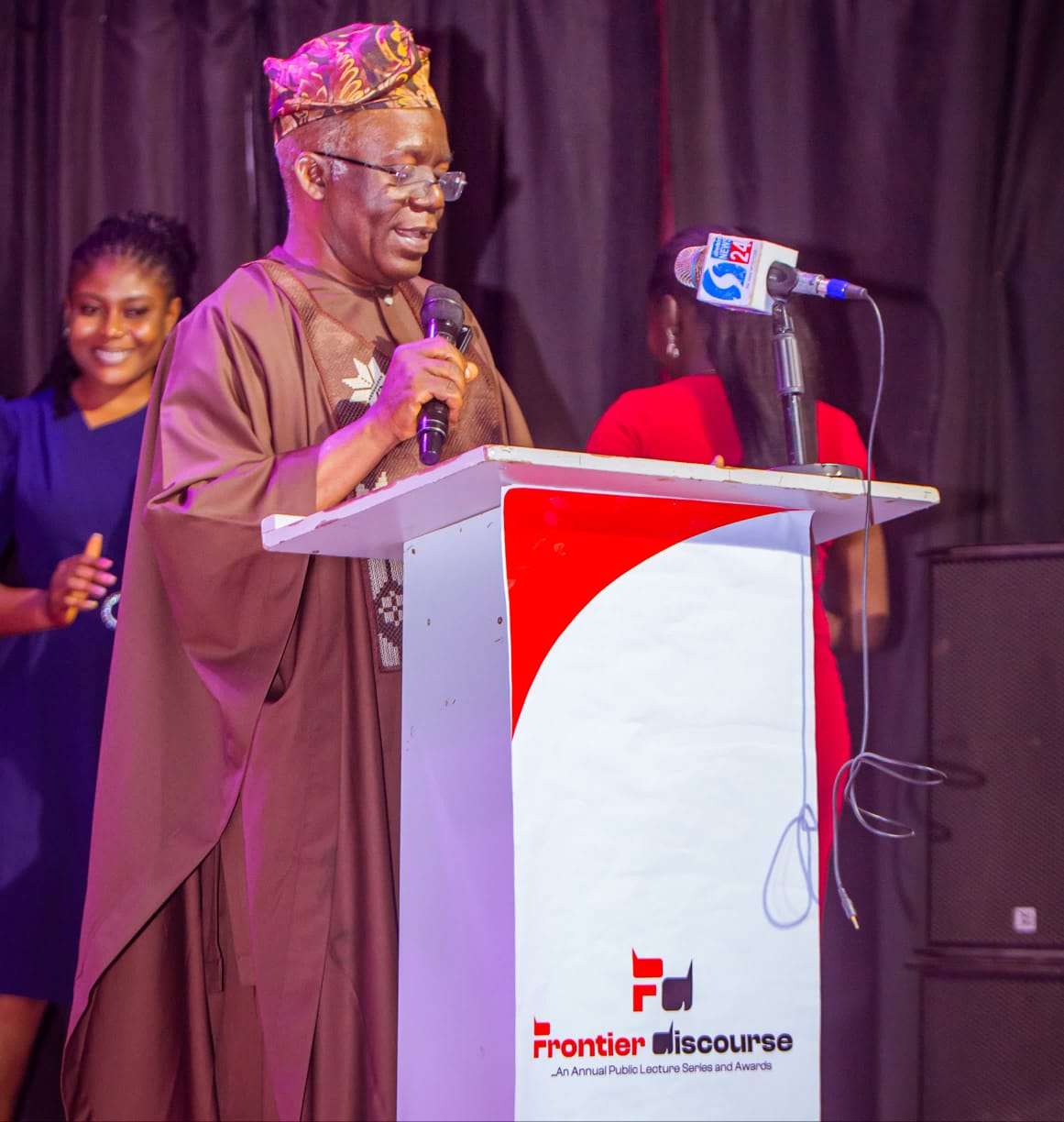
Falana made the calls on Tuesday while delivering the keynote address at the sixth edition of the Frontier Discourse Annual Public Lecture Series and Awards, organised by Pacesetter Frontier Magazine at Merit House, Maitama, Abuja. He also received the Frontier Person Award at the event.
The lecture, themed, “Barrel to Ballot: The Naturalisation of Violence, Nigeria’s Polity, and its Democratic Circus,” brought together stakeholders who expressed concern over political thuggery, restrictions on opposition campaigns, unemployment, insecurity and the failure to enforce laws protecting citizens.
Speaking on electoral accountability, Falana urged the Independent National Electoral Commission (INEC) to establish a dedicated prosecution unit to investigate and prosecute electoral offenders.
He said the commission should obtain reports from the police and other security agencies, investigate alleged violations and take those found culpable to court.
Falana argued that the Electoral Act placed the responsibility for prosecuting electoral offenders on INEC, stressing that the commission should not leave the task entirely to the police and other security agencies.
“I am suggesting that INEC should have a prosecution unit with a view to getting reports from the police and other security agencies about electoral offences and then take them to court,” he said.
The senior advocate also faulted the National Assembly for failing to implement the recommendation for the establishment of an Electoral Offences Commission, alleging that politicians were deliberately allowing political thuggery to continue because of its usefulness to their interests.
“The politicians in Abuja, members of the National Assembly have refused, deliberately so, to implement the recommendation that there shall be in the country an electoral offences commission.
“Politicians do not want to distort the status quo. So they want us to continue to live with thuggery because the thugs are agents of politicians from all the political spectrum,” he said.
Falana warned against portraying political violence as the exclusive preserve of any political party, noting that supporters of both the ruling party and opposition parties had been involved in attacks and other acts of violence.
He alleged that opposition parties had been prevented from erecting campaign billboards in some states, while supporters of different political parties had engaged in vandalism and attacks against their opponents.
He insisted that no political party should claim innocence or justify violence against its opponents, maintaining that all political actors must be held accountable for their actions.
The lawyer also criticised state governments for allegedly imposing excessive charges on campaign billboards, saying some had introduced guidelines capable of limiting opposition parties’ access to campaign platforms.
“In some states or many states in the country, state governments have brought out obnoxious electoral guidelines. If you want to erect your billboard, you must pay a fee of about N150m to N200m depending on which position you are contesting for.
“I have submitted here that no state government has the power under the law to monetise campaign,” he said.
Falana maintained that INEC was constitutionally empowered to issue guidelines for national elections and monitor political campaigns. He argued that state governments and other authorities should not introduce measures that restrict political participation.
He called on the electoral commission to intervene and ensure that political parties and state governments withdrew actions capable of interfering with the electoral process.
Citing the case of Balarabe Musa v. INEC, he argued that electoral guidelines must conform with the Constitution and should not be used to restrict the civic space.
On the responsibilities of political parties, Falana said the Constitution required them to adopt and implement the fundamental objectives and directive principles of state policy, including provisions relating to education, healthcare and citizens’ welfare.
Although Chapter Two of the Constitution is generally regarded as non-justiciable, he noted that some of its provisions had been given legal force through specific legislation.
Citing the Child Rights Act, he said state governments had enacted laws providing for free and compulsory education from primary to secondary school, but poor implementation had left millions of children without access to education.
He also identified the National Health Insurance Act and the Pension Reform Act as examples of legislation giving practical effect to citizens’ social and economic rights.
Falana urged young Nigerians to hold political office seekers accountable by questioning their records on employment, security, social protection and education rather than allowing themselves to be recruited for electoral violence.
He said political campaigns should provide opportunities for citizens to demand clear explanations from candidates on how they planned to address the needs of young people and vulnerable groups.
He further argued that unemployed Nigerians should be able to approach relevant government institutions, including local government offices and the National Directorate of Employment, for assistance in line with constitutional provisions.
On social protection, the senior advocate maintained that cash transfers to poor and vulnerable Nigerians should be treated as an obligation rather than merely a government policy.
Falana Calls for BRICS Membership, Alternative Economic Policies
Turning to the economy, Falana called on the Federal Government to pursue full membership of the BRICS bloc and adopt alternative economic programmes to address poverty, unemployment and revenue leakages.
He noted that Nigeria became a BRICS partner country in January 2025 but urged the government to take its participation further by seeking full membership.
According to him, BRICS provides an opportunity for participating countries to challenge the dominance of the United States dollar and deepen trade and economic cooperation using their national currencies.
“It’s an organisation set up to challenge the dominance of the dollar, to challenge the West, to mould the full-fledged members so that we can take advantage and trade among ourselves in your own currencies,” he said.
The lawyer also questioned the abandonment of the Nigeria-China currency swap arrangement, arguing that the country should explore opportunities to strengthen trade and economic relations.
He identified domestic refining of crude oil as another priority, saying Nigeria could derive greater economic benefits from processing its natural resources locally instead of depending heavily on imported petroleum products.
“Even within the bourgeois paradigm, within the bourgeois framework, consider some of them, including refining crude oil for domestic consumption in Nigeria,” he said.
Falana also criticised the economic policies promoted by international financial institutions, particularly the International Monetary Fund (IMF) and the World Bank, arguing that their prescriptions had failed to deliver the desired development outcomes for developing countries.
“No country in the world, none, has ever been developed by implementing the policies of these Bretton Woods institutions that were set up to underdevelop the economies of third world countries,” he said.
On revenue losses, he referred to a 2021 government report on cargo tracking, which he said indicated that Nigeria lost $32bn during the 13 years the system was suspended.
He estimated that the country lost an additional $10bn between 2021 and 2025, arguing that cargo tracking and other revenue-monitoring mechanisms could help address financial leakages.
Falana questioned the country’s continued reliance on policies promoted by international financial institutions and called for economic programmes that would prioritise local production, self-reliance and improved living conditions.
He maintained that Nigeria could achieve prosperity within a capitalist economic framework if government policies were designed to benefit the wider population rather than a few individuals.
“I’m not campaigning here for the socialist reconstruction of Nigeria. That will be done elsewhere. But within your own capitalist ethos, you can run this economy in a way that will be beneficial to the entirety of the Nigerian people,” he said.
He added that the implementation of neoliberal economic policies could undermine efforts to achieve widespread prosperity.
“There can be no prosperity when you implement neoliberal policies,” he said.
Falana declared that Nigeria had no business remaining in poverty and urged the government to reconsider its economic direction, strengthen local production and manage national resources more effectively.
He concluded by calling on young Nigerians to exercise their sovereign power through the ballot rather than engage in activities capable of undermining the country.
He urged them to participate actively in the 2027 general elections and vote for candidates of their choice at the federal, state and local government levels.
It takes a lot to get credible, true and reliable stories.
As a privately owned media outfit, we believe in setting the pace and leaving strides in time.
If you like what we do, you can donate a token to us here. Your support will ensure that the right news is put out there at all times, reaching an unlimited number of persons at no cost to them.
Comments expressed below by readers do not reflect the opinions of Pacesetter Frontier Magazine or any employee thereof.
Advertisement
Leave your reply!